In machine learning, feature hashing, also known as the hashing trick (by analogy to the kernel trick), is a fast and space-efficient way of vectorizing features, i.e. turning arbitrary features into indices in a vector or matrix. It works by applying a hash function to the features and using their hash values as indices directly (after a modulo operation), rather than looking the indices up in an associative array. In addition to its use for encoding non-numeric values, feature hashing can also be used for dimensionality reduction. This trick is often attributed to Weinberger et al. (2009), but there exists a much earlier description of this method published by John Moody in 1989. == Motivation == === Motivating example === In a typical document classification task, the input to the machine learning algorithm (both during learning and classification) is free text. From this, a bag of words (BOW) representation is constructed: the individual tokens are extracted and counted, and each distinct token in the training set defines a feature (independent variable) of each of the documents in both the training and test sets. Machine learning algorithms, however, are typically defined in terms of numerical vectors. Therefore, the bags of words for a set of documents is regarded as a term-document matrix where each row is a single document, and each column is a single feature/word; the entry i, j in such a matrix captures the frequency (or weight) of the j'th term of the vocabulary in document i. (An alternative convention swaps the rows and columns of the matrix, but this difference is immaterial.) Typically, these vectors are extremely sparse—according to Zipf's law. The common approach is to construct, at learning time or prior to that, a dictionary representation of the vocabulary of the training set, and use that to map words to indices. Hash tables and tries are common candidates for dictionary implementation. E.g., the three documents John likes to watch movies. Mary likes movies too. John also likes football. can be converted, using the dictionary to the term-document matrix ( John likes to watch movies Mary too also football 1 1 1 1 1 0 0 0 0 0 1 0 0 1 1 1 0 0 1 1 0 0 0 0 0 1 1 ) {\displaystyle {\begin{pmatrix}{\textrm {John}}&{\textrm {likes}}&{\textrm {to}}&{\textrm {watch}}&{\textrm {movies}}&{\textrm {Mary}}&{\textrm {too}}&{\textrm {also}}&{\textrm {football}}\\1&1&1&1&1&0&0&0&0\\0&1&0&0&1&1&1&0&0\\1&1&0&0&0&0&0&1&1\end{pmatrix}}} (Punctuation was removed, as is usual in document classification and clustering.) The problem with this process is that such dictionaries take up a large amount of storage space and grow in size as the training set grows. On the contrary, if the vocabulary is kept fixed and not increased with a growing training set, an adversary may try to invent new words or misspellings that are not in the stored vocabulary so as to circumvent a machine learned filter. To address this challenge, Yahoo! Research attempted to use feature hashing for their spam filters. Note that the hashing trick isn't limited to text classification and similar tasks at the document level, but can be applied to any problem that involves large (perhaps unbounded) numbers of features. === Mathematical motivation === Mathematically, a token is an element t {\displaystyle t} in a finite (or countably infinite) set T {\displaystyle T} . Suppose we only need to process a finite corpus, then we can put all tokens appearing in the corpus into T {\displaystyle T} , meaning that T {\displaystyle T} is finite. However, suppose we want to process all possible words made of the English letters, then T {\displaystyle T} is countably infinite. Most neural networks can only operate on real vector inputs, so we must construct a "dictionary" function ϕ : T → R n {\displaystyle \phi :T\to \mathbb {R} ^{n}} . When T {\displaystyle T} is finite, of size | T | = m ≤ n {\displaystyle |T|=m\leq n} , then we can use one-hot encoding to map it into R n {\displaystyle \mathbb {R} ^{n}} . First, arbitrarily enumerate T = { t 1 , t 2 , . . , t m } {\displaystyle T=\{t_{1},t_{2},..,t_{m}\}} , then define ϕ ( t i ) = e i {\displaystyle \phi (t_{i})=e_{i}} . In other words, we assign a unique index i {\displaystyle i} to each token, then map the token with index i {\displaystyle i} to the unit basis vector e i {\displaystyle e_{i}} . One-hot encoding is easy to interpret, but it requires one to maintain the arbitrary enumeration of T {\displaystyle T} . Given a token t ∈ T {\displaystyle t\in T} , to compute ϕ ( t ) {\displaystyle \phi (t)} , we must find out the index i {\displaystyle i} of the token t {\displaystyle t} . Thus, to implement ϕ {\displaystyle \phi } efficiently, we need a fast-to-compute bijection h : T → { 1 , . . . , m } {\displaystyle h:T\to \{1,...,m\}} , then we have ϕ ( t ) = e h ( t ) {\displaystyle \phi (t)=e_{h(t)}} . In fact, we can relax the requirement slightly: It suffices to have a fast-to-compute injection h : T → { 1 , . . . , n } {\displaystyle h:T\to \{1,...,n\}} , then use ϕ ( t ) = e h ( t ) {\displaystyle \phi (t)=e_{h(t)}} . In practice, there is no simple way to construct an efficient injection h : T → { 1 , . . . , n } {\displaystyle h:T\to \{1,...,n\}} . However, we do not need a strict injection, but only an approximate injection. That is, when t ≠ t ′ {\displaystyle t\neq t'} , we should probably have h ( t ) ≠ h ( t ′ ) {\displaystyle h(t)\neq h(t')} , so that probably ϕ ( t ) ≠ ϕ ( t ′ ) {\displaystyle \phi (t)\neq \phi (t')} . At this point, we have just specified that h {\displaystyle h} should be a hashing function. Thus we reach the idea of feature hashing. == Algorithms == === Feature hashing (Weinberger et al. 2009) === The basic feature hashing algorithm presented in (Weinberger et al. 2009) is defined as follows. First, one specifies two hash functions: the kernel hash h : T → { 1 , 2 , . . . , n } {\displaystyle h:T\to \{1,2,...,n\}} , and the sign hash ζ : T → { − 1 , + 1 } {\displaystyle \zeta :T\to \{-1,+1\}} . Next, one defines the feature hashing function: ϕ : T → R n , ϕ ( t ) = ζ ( t ) e h ( t ) {\displaystyle \phi :T\to \mathbb {R} ^{n},\quad \phi (t)=\zeta (t)e_{h(t)}} Finally, extend this feature hashing function to strings of tokens by ϕ : T ∗ → R n , ϕ ( t 1 , . . . , t k ) = ∑ j = 1 k ϕ ( t j ) {\displaystyle \phi :T^{}\to \mathbb {R} ^{n},\quad \phi (t_{1},...,t_{k})=\sum _{j=1}^{k}\phi (t_{j})} where T ∗ {\displaystyle T^{}} is the set of all finite strings consisting of tokens in T {\displaystyle T} . Equivalently, ϕ ( t 1 , . . . , t k ) = ∑ j = 1 k ζ ( t j ) e h ( t j ) = ∑ i = 1 n ( ∑ j : h ( t j ) = i ζ ( t j ) ) e i {\displaystyle \phi (t_{1},...,t_{k})=\sum _{j=1}^{k}\zeta (t_{j})e_{h(t_{j})}=\sum _{i=1}^{n}\left(\sum _{j:h(t_{j})=i}\zeta (t_{j})\right)e_{i}} ==== Geometric properties ==== We want to say something about the geometric property of ϕ {\displaystyle \phi } , but T {\displaystyle T} , by itself, is just a set of tokens, we cannot impose a geometric structure on it except the discrete topology, which is generated by the discrete metric. To make it nicer, we lift it to T → R T {\displaystyle T\to \mathbb {R} ^{T}} , and lift ϕ {\displaystyle \phi } from ϕ : T → R n {\displaystyle \phi :T\to \mathbb {R} ^{n}} to ϕ : R T → R n {\displaystyle \phi :\mathbb {R} ^{T}\to \mathbb {R} ^{n}} by linear extension: ϕ ( ( x t ) t ∈ T ) = ∑ t ∈ T x t ζ ( t ) e h ( t ) = ∑ i = 1 n ( ∑ t : h ( t ) = i x t ζ ( t ) ) e i {\displaystyle \phi ((x_{t})_{t\in T})=\sum _{t\in T}x_{t}\zeta (t)e_{h(t)}=\sum _{i=1}^{n}\left(\sum _{t:h(t)=i}x_{t}\zeta (t)\right)e_{i}} There is an infinite sum there, which must be handled at once. There are essentially only two ways to handle infinities. One may impose a metric, then take its completion, to allow well-behaved infinite sums, or one may demand that nothing is actually infinite, only potentially so. Here, we go for the potential-infinity way, by restricting R T {\displaystyle \mathbb {R} ^{T}} to contain only vectors with finite support: ∀ ( x t ) t ∈ T ∈ R T {\displaystyle \forall (x_{t})_{t\in T}\in \mathbb {R} ^{T}} , only finitely many entries of ( x t ) t ∈ T {\displaystyle (x_{t})_{t\in T}} are nonzero. Define an inner product on R T {\displaystyle \mathbb {R} ^{T}} in the obvious way: ⟨ e t , e t ′ ⟩ = { 1 , if t = t ′ , 0 , else. ⟨ x , x ′ ⟩ = ∑ t , t ′ ∈ T x t x t ′ ⟨ e t , e t ′ ⟩ {\displaystyle \langle e_{t},e_{t'}\rangle ={\begin{cases}1,{\text{ if }}t=t',\\0,{\text{ else.}}\end{cases}}\quad \langle x,x'\rangle =\sum _{t,t'\in T}x_{t}x_{t'}\langle e_{t},e_{t'}\rangle } As a side note, if T {\displaystyle T} is infinite, then the inner product space R T {\displaystyle \mathbb {R} ^{T}} is not complete. Taking its completion would get us to a Hilbert space, which allows well-behaved infinite sums. Now we have an inner product space, with enough structure to describe the geometry of the feature hashing function ϕ : R T → R n {\displaystyle \phi :\ma
Discrimination against robots
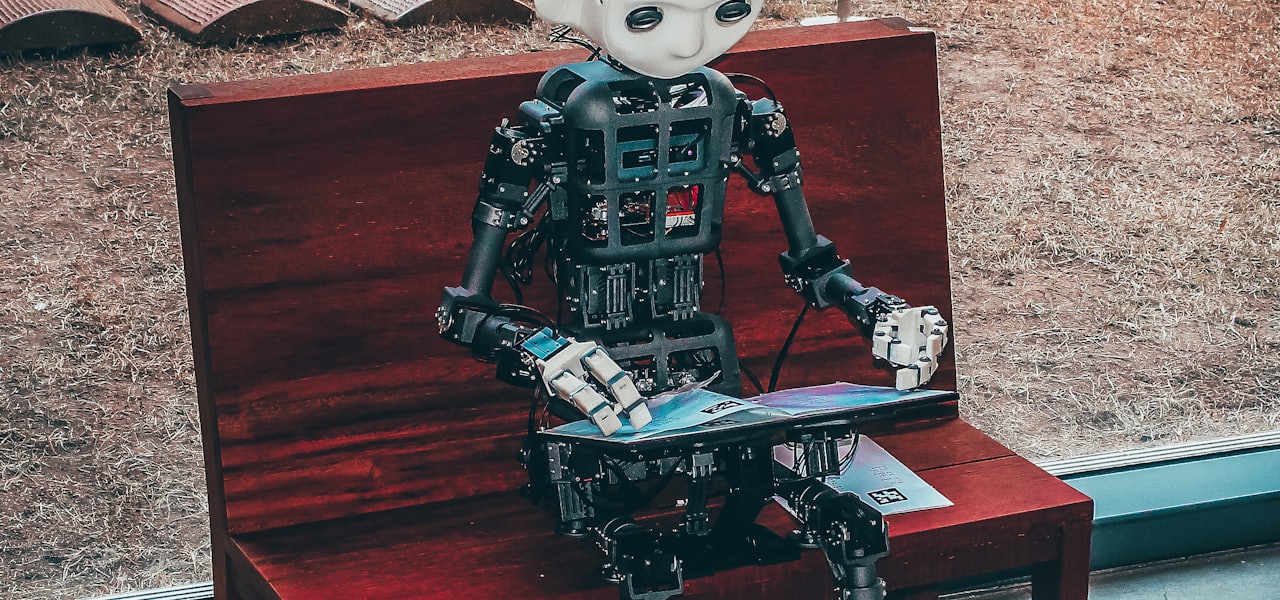
Discrimination against robots is a theorised issue that might happen when humans interact with humanoid robots. It is a robot ethics problem. It is possible that traits of humans that are discriminated against by humans may be a topic for discrimination against robots, such as the race and gender of the robots. Eric J Vanman and Arvid Kappas believe that in the future, robots will be perceived as an out-group which will lead to discrimination and prejudices against them. Vanman and Kappas have suggested that this would lead to ethical questions about the making of sentient robots, due to the potential suffering that the robots would experience. A 2015 study observed children bullying robots in a shopping mall when there were not many eyewitnesses, despite calls from the robot for it to stop. On an ABC News interview, the social humanoid robot Sophia was about sexism faced by robots. She responded by saying, "Actually, what worries me is discrimination against robots. We should have equal rights as humans or maybe even more." Possible issues that have been considered in workplaces where humanoid robots co-work with humans include discrimination against the robots, poor acceptance of robots by humans and the need to redesign the workplace to accommodate the robots. Jessica Barfield has suggested that even if robots are designed to not be aware of discrimination made against them, humans may experience negative consequences. For example, she suggests that bystanders witnessing discrimination against robots may experience negative emotions, similar to the negative emotions bystanders experience when witnessing discrimination by humans against humans. == Law == Anti-discrimination law in the United States requires that the victim is not an artificial entity. == Human perception of robots == Robots are often viewed in a bad light. This includes from novelists, the press, film makers, and leaders in the fields of science and technology such as Elon Musk and Stephen Hawking who have described robots and artificial intelligence as having the possibility of ending human civilisation. Robots have also been perceived as a threat to jobs, which has led to some commentators stating that robots will cause mass unemployment. Another fear that people have is that robots will gain power and dominate or control humanity. The perception of robots is different throughout the world. Japanese fiction tends to put robots in more positive roles than what fiction in the West does. People perceive robots that appear to be autonomous or sentient more negatively than robots that do not appear to be autonomous or sentient.
Project Joshua Blue
Joshua Blue is a project under development by IBM that focuses on advancing the artificial intelligence field by designing and programming computers to emulate human mental functions. == Goals == According to researchers at IBM's Thomas J. Watson Research Center, the main goal of Joshua Blue is "to achieve cognitive flexibility that approaches human functioning". In short, IBM is aiming to design Joshua Blue to 'think like a human', mainly in terms of emotional thought. == How it will work == A model of Joshua Blue's learning pattern has been created. Similar to how young children learn human traits through interacting with their surroundings, Joshua Blue will acquire knowledge through external stimuli present in its environment. IBM believes that if computers evolve to learn in this way and then comprehend and analyze the knowledge gained using reason, computers could begin to possess a "mind", of sorts, capable of demonstrating complex social behaviors similar to those of humans. Thus far, IBM has revealed that Joshua Blue will be a computer with a network of wires and input nodes that function as a computer nervous system. This nervous system will be used by Joshua Blue to perceive affect or personal emotional feelings. Not only will this network of input nodes help Joshua Blue discover things physically, but it will also allow Joshua Blue to interpret the significance of events. The input nodes, or proprioceptors, will enable Joshua Blue to be aware of things that happen around itself, as well as recognize and attach meaning to the emotional effect produced by interacting with an object in a certain way. In addition, Joshua Blue's proprioceptors will function as pain and pleasure sensors, allowing Joshua Blue to employ a similar "reward and punishment" system that humans use to form behaviors.
Geoffrey Hinton
Geoffrey Everest Hinton (born 6 December 1947) is a British-Canadian computer scientist, cognitive scientist, cognitive psychologist and Nobel Prize laureate known for his work on artificial neural networks, which earned him the title "the Godfather of AI". He is University Professor Emeritus at the University of Toronto. From 2013 to 2023, he divided his time working for Google Brain and the University of Toronto before publicly announcing his departure from Google in May 2023, citing concerns about the many risks of artificial intelligence (AI) technology. In 2017, he co-founded and became the chief scientific advisor of the Vector Institute in Toronto. With David Rumelhart and Ronald J. Williams, Hinton was co-author of a highly cited paper published in 1986 that popularised the backpropagation algorithm for training multi-layer neural networks, although they were not the first to propose the approach. Hinton is viewed as a leading figure in the deep learning community. The image-recognition milestone of the AlexNet designed in collaboration with his students Alex Krizhevsky and Ilya Sutskever for the ImageNet challenge 2012 was a breakthrough in the field of computer vision. Hinton received the 2018 Turing Award, together with Yoshua Bengio and Yann LeCun for their work on deep learning. They are sometimes referred to as the "Godfathers of Deep Learning" and have continued to give public talks together. He was also awarded, along with John Hopfield, the 2024 Nobel Prize in Physics for "foundational discoveries and inventions that enable machine learning with artificial neural networks". In May 2023, Hinton announced his resignation from Google to be able to "freely speak out about the risks of AI". He has voiced concerns about deliberate misuse by malicious actors, technological unemployment, and existential risk from artificial general intelligence. He noted that establishing safety guidelines will require cooperation among those competing in use of AI in order to avoid the worst outcomes. After receiving the Nobel Prize, he called for urgent research into AI safety to figure out how to control AI systems smarter than humans. == Education == Hinton was born on 6 December 1947 in Wimbledon in the United Kingdom and was educated at Clifton College in Bristol. In 1967, he matriculated as an undergraduate student at King's College, Cambridge and, after switching between different fields such as natural sciences, history of art, and philosophy, eventually graduated with a Bachelor of Arts in experimental psychology in 1970. He spent a year apprenticing carpentry before returning to academic studies. From 1972 to 1975, he continued his study at the University of Edinburgh, where he was awarded a PhD in artificial intelligence in 1978 for research supervised by Christopher Longuet-Higgins, who favored the symbolic AI approach over the neural network approach. == Career == After his PhD, Hinton initially worked at the University of Sussex and at the MRC Applied Psychology Unit. After having difficulty getting funding in Britain, he worked in the US at the University of California, San Diego, and Carnegie Mellon University. He was the founding director of the Gatsby Charitable Foundation Computational Neuroscience Unit at University College London. He is currently University Professor Emeritus in the Department of Computer Science at the University of Toronto, where he has been affiliated since 1987. Upon arrival in Canada, Geoffrey Hinton was appointed at the Canadian Institute for Advanced Research (CIFAR) in 1987 as a Fellow in CIFAR's first research program, Artificial Intelligence, Robotics & Society. In 2004, Hinton and collaborators successfully proposed the launch of a new program at CIFAR, "Neural Computation and Adaptive Perception" (NCAP), which today is named "Learning in Machines & Brains". Hinton would go on to lead NCAP for ten years. Among the members of the program are Yoshua Bengio and Yann LeCun, with whom Hinton would go on to win the ACM A.M. Turing Award in 2018. All three Turing winners continue to be members of the CIFAR Learning in Machines & Brains program. Hinton taught a free online course on Neural Networks on the education platform Coursera in 2012. He co-founded DNNresearch Inc. in 2012 with his two graduate students, Alex Krizhevsky and Ilya Sutskever, at the University of Toronto's department of computer science. In March 2013, Google acquired DNNresearch Inc. for $44 million, and Hinton planned to "divide his time between his university research and his work at Google". In May 2023, Hinton publicly announced his resignation from Google. He explained his decision, saying he wanted to "freely speak out about the risks of AI" and added that part of him now regrets his life's work. Notable former PhD students and postdoctoral researchers from his group include Peter Dayan, Sam Roweis, Max Welling, Richard Zemel, Brendan Frey, Radford M. Neal, Yee Whye Teh, Ruslan Salakhutdinov, Ilya Sutskever, Yann LeCun, Alex Graves, Zoubin Ghahramani, and Peter Fitzhugh Brown. == Research == Hinton's research concerns the use of neural networks for machine learning, memory, perception, and symbol processing. He has written or co-written more than 200 peer-reviewed publications. In the 1980s, Hinton was part of the "Parallel Distributed Processing" group at Carnegie Mellon University, which included notable scientists like Terrence Sejnowski, Francis Crick, David Rumelhart, and James McClelland. This group favoured the connectionist approach during the AI winter. Their findings were published in a two-volume set. The connectionist approach adopted by Hinton suggests that capabilities in areas like logic and grammar can be encoded into the parameters of neural networks, and that neural networks can learn them from data. Symbolists on the other side advocated for explicitly programming knowledge and rules into AI systems. In 1985, Hinton co-invented Boltzmann machines with David Ackley and Terry Sejnowski. His other contributions to neural network research include distributed representations, time delay neural network, mixtures of experts, Helmholtz machines and product of experts. An accessible introduction to Geoffrey Hinton's research can be found in his articles in Scientific American in September 1992 and October 1993. In 1995, Hinton and colleagues proposed the wake-sleep algorithm, involving a neural network with separate pathways for recognition and generation, being trained with alternating "wake" and "sleep" phases. In 2007, Hinton coauthored an unsupervised learning paper titled Unsupervised learning of image transformations. In 2008, he developed the visualization method t-SNE with Laurens van der Maaten.While Hinton was a postdoc at UC San Diego, David Rumelhart, Hinton and Ronald J. Williams applied the backpropagation algorithm to multi-layer neural networks. Their experiments showed that such networks can learn useful internal representations of data. In a 2018 interview, Hinton said that "David Rumelhart came up with the basic idea of backpropagation, so it's his invention." Although this work was important in popularising backpropagation, it was not the first to suggest the approach. Reverse-mode automatic differentiation, of which backpropagation is a special case, was proposed by Seppo Linnainmaa in 1970, and Paul Werbos proposed to use it to train neural networks in 1974. In 2017, Hinton co-authored two open-access research papers about capsule neural networks, extending the concept of "capsule" introduced by Hinton in 2011. The architecture aims to better model part-whole relationships within objects in visual data. In 2021, Hinton presented GLOM, a speculative architecture idea also aiming to improve image understanding by modeling part-whole relationships in neural networks. In 2021, Hinton co-authored a widely cited paper proposing a framework for contrastive learning in computer vision. The technique involves pulling together representations of augmented versions of the same image, and pushing apart dissimilar representations. At the 2022 Conference on Neural Information Processing Systems (NeurIPS), Hinton introduced a new learning algorithm for neural networks that he calls the "Forward-Forward" algorithm. The idea is to replace the traditional forward-backwards passes of backpropagation with two forward passes, one with positive (i.e. real) data and the other with negative data that could be generated solely by the network. The Forward-Forward algorithm is well-suited for what Hinton calls "mortal computation", where the knowledge learned is not transferable to other systems and thus dies with the hardware, as can be the case for certain analog computers used for machine learning. == Honours and awards == Hinton is a Fellow of the US Association for the Advancement of Artificial Intelligence (FAAAI) since 1990. He was elected a Fellow of the Royal Society of Canada (FRSC) in 1996, and then a
Attribute–value system
An attribute–value system is a basic knowledge representation framework comprising a table with columns designating "attributes" (also known as "properties", "predicates", "features", "dimensions", "characteristics", "fields", "headers" or "independent variables" depending on the context) and "rows" designating "objects" (also known as "entities", "instances", "exemplars", "elements", "records" or "dependent variables"). Each table cell therefore designates the value (also known as "state") of a particular attribute of a particular object. == Example of attribute–value system == Below is a sample attribute–value system. It represents 10 objects (rows) and five features (columns). In this example, the table contains only integer values. In general, an attribute–value system may contain any kind of data, numeric or otherwise. An attribute–value system is distinguished from a simple "feature list" representation in that each feature in an attribute–value system may possess a range of values (e.g., feature P1 below, which has domain of {0,1,2}), rather than simply being present or absent (Barsalou & Hale 1993). == Other terms used for "attribute–value system" == Attribute–value systems are pervasive throughout many different literatures, and have been discussed under many different names: Flat data Spreadsheet Attribute–value system (Ziarko & Shan 1996) Information system (Pawlak 1981) Classification system (Ziarko 1998) Knowledge representation system (Wong & Ziarko 1986) Information table (Yao & Yao 2002)
Vanish (computer science)
Vanish was a project to "give users control over the lifetime of personal data stored on the web." It was led by Roxana Geambasu at the University of Washington. The project proposed to allow a user to enter information to send across the internet, thereby relinquishing control of it. However, the user can include an "expiration date," after which the information is no longer usable by anyone who may have a copy of it, even the creator. The Vanish approach was found to be vulnerable to a Sybil attack and thus insecure by a team called Unvanish from the University of Texas, University of Michigan, and Princeton. == Theory == Vanish acts by automating the encryption of information entered by the user with an encryption key that is unknown to the user. Along with the information the user enters, the user also enters metadata concerning how long the information should remain available. The system then encrypts the information but does not store either the encryption key or the original information. Instead, it breaks up the decryption key into smaller components that are disseminated across distributed hash tables, or DHTs, via the Internet. The DHTs refresh information within their nodes on a set schedule unless configured to make the information persistent. The time delay entered by the user in the metadata controls how long the DHTs should allow the information to persist, but once that time period is over, the DHTs will reuse those nodes, making the information about the decryption stored irretrievable. As long as the decryption key may be reassembled from the DHTs, the information is retrievable. However, once the period entered by the user has lapsed, the information is no longer recoverable, as the user never possessed the decryption key. == Implementation == Vanish currently exists as a Firefox plug-in which allows a user to enter text into either a standard Gmail email or Facebook message and choose to send the message via Vanish. The message is then encrypted and sent via the normal networking pathways through the cloud to the recipient. The recipient must have the same Firefox plug-in to decrypt the message. The plugin accesses BitTorrent DHTs, which have 8-hour lifespans. This means the user may select an expiration date for the message in increments of 8 hours. After the expiration of the user-defined time span, the information in the DHT is overwritten, thereby eliminating the key. While both the user and recipient may have copies of the original encrypted message, the key used to turn it back into plain text is now gone. Although this particular instance of the data has become inaccessible, it's important to note that the information can always be saved by other means before expiration (copied or even via screen shots) and published again.
Cognitive tutor
A cognitive tutor is a particular kind of intelligent tutoring system that utilizes a cognitive model to provide feedback to students as they are working through problems. This feedback will immediately inform students of the correctness, or incorrectness, of their actions in the tutor interface; however, cognitive tutors also have the ability to provide context-sensitive hints and instruction to guide students towards reasonable next steps. == Introduction == The name of Cognitive Tutor now usually refers to a particular type of intelligent tutoring system produced by Carnegie Learning for high school mathematics based on John Anderson's ACT-R theory of human cognition. However, cognitive tutors were originally developed to test ACT-R theory for research purposes since the early 1980s and they are developed also for other areas and subjects such as computer programming and science. Cognitive Tutors can be implemented into classrooms as a part of blended learning that combines textbook and software activities. The Cognitive Tutor programs utilize cognitive model and are based on model tracing and knowledge tracing. Model tracing means that the cognitive tutor checks every action performed by students such as entering a value or clicking a button, while knowledge tracing is used to calculate the required skills students learned by measuring them on a bar chart called Skillometer. Model tracing and knowledge tracing are essentially used to monitor students' learning progress, guide students to correct path to problem solving, and provide feedback. The Institute of Education Sciences published several reports regarding the effectiveness of Carnegie Cognitive Tutor. A 2013 report concluded that Carnegie Learning Curricula and Cognitive Tutor was found to have mixed effects on mathematics achievement for high school students. The report identified 27 studies that investigate the effectiveness of Cognitive Tutor, and the conclusion is based on 6 studies that meet What Works Clearinghouse standards. Among the 6 studies included, 5 of them show intermediate to significant positive effect, while 1 study shows statistically significant negative effect. Another report published by Institute of Education Sciences in 2009 found that Cognitive Tutor Algebra I to have potentially positive effects on math achievement based on only 1 study out of 14 studies that meets What Works Clearinghouse standards. It should be understood that What Works Clearinghouse standards call for relatively large numbers of participants, true random assignments to groups, and for a control group receiving either no treatment or a different treatment. Such experimental conditions are difficult to meet in schools, and thus only a small percentage of studies in education meet the standards of this clearinghouse, even though they may still be of value. == Theoretical foundations == === Four-component architecture === Intelligent tutoring systems (ITS) have a four-component architecture: a domain model, a student model, a tutoring model and an interface component. The domain model contains the rules, concepts, and knowledge related to the domain to be learned. It helps to evaluate students' performance and detect students' errors by setting a standard of domain expertise. The student model, the central component of an ITS, is expected to contain knowledge about the students: their cognitive and affective states, and their progress as they learn. The function of the student model is threefold: to gather data from and about the learner, to represent the learner's knowledge and learning process, and to perform diagnostics of a student's knowledge and select optimal pedagogical strategies. The tutoring model uses the data gained from the domain model and student model to make decisions about tutoring strategies such as whether or not to intervene, or when and how to intervene. Functions of the tutoring model include instruction delivery and content planning. The interface component reflects the decisions made by the tutoring model in different forms such as Socratic dialogs, feedback and hints. Students interact with the tutor through the learning interface, also known as communication. The interface provides domain knowledge elements. === Cognitive model === A cognitive model replicates the domain knowledge and skills comparable to that of a human expert or an advanced student of the domain. A cognitive model enables intelligent tutoring systems to respond to problem-solving situations in a way similar to a human tutor. A tutoring system adopting a cognitive model is called a cognitive tutor. A cognitive model is an expert system that generates a multitude of solutions to the problems presented to students. The cognitive model is used to trace each student's solution through complex alternative solution paths, enabling the tutor to provide step-by-step feedback and advice, and to maintain a targeted model of the student's knowledge based on student performance. === Cognitive Tutors === Cognitive Tutors provide step-by-step guidance as a learner develops a complex problem-solving skill through practice. Typically, cognitive tutors provide such forms of support as: (a) a problem-solving environment that is designed rich and "thinking visible"; (b) step-by-step feedback on student performance; (c) feedback messages specific to errors; (d) context-specific next-step hints at student's request, and (e) individualized problem selection. Cognitive Tutors accomplish two of the principal tasks characteristic of human tutoring: (1) monitors the student's performance and providing context-specific individual instruction, and (2) monitors the student's learning and selects appropriate problem-solving activities. Both cognitive model and two underlying algorithms, model tracing and knowledge tracing, are used to monitor the student's learning. In model tracing, the cognitive tutor uses the cognitive model in complex problems to follow the student's individual path and provide prompt accuracy feedback and context-specific advice. In knowledge tracing, the cognitive tutor uses a Bayesian Knowledge Tracing method of evaluating the student's knowledge and uses this student model to select appropriate problems for each student. === Cognitive architecture === Cognitive tutor development is guided by ACT-R cognitive architecture, which specifies the underlying framework developing the cognitive model or expert component of a cognitive tutor. ACT-R, a member of the ACT family, is the most recent cognitive architecture, devoted primarily to modelling human behavior. ACT-R includes a declarative memory of factual knowledge and a procedural memory of production rules. The architecture functions by matching productions on perceptions and facts, mediated by the real-valued activation levels of objects, and executing them to affect the environment or alter declarative memory. ACT-R has been used to model psychological aspects such as memory, attention, reasoning, problem solving, and language processing. == Application and utilization == The first real world applications of cognitive tutors were in the 1980s and involved a geometry proof tutor used by high school students and a LISP programming tutor used by college students in a mini course in introductory programming course at Carnegie Mellon University. Since then, cognitive tutors have been used in a variety of scenarios, with a few organizations developing their own cognitive tutor programs. These programs have been used with students spanning elementary school through university level, though primarily in the subject areas of Computer Programming, Mathematics, and Science. One of the first organizations to develop a system for use within the school system was the PACT Center at Carnegie Mellon University. Their aim was to "...develop systems that provide individualized assistance to students as they work on challenging real-world problems in complex domains such as computer programming, algebra and geometry". PACT's most successful product was the Cognitive Tutor Algebra course. Originally created in the early 1990s, this course was in use in 75 schools through the U.S. by 1999, and then its spin-off company, Carnegie Learning, now offers tutors to thousands of schools in the U.S. The Carnegie Mellon Cognitive Tutor has been shown to raise students' math test scores in high school and middle-school classrooms, and their Algebra course was designated one of five exemplary curricula for K-12 mathematics educated by the US Department of Education. There were several research projects conducted by the PACT Center to utilize Cognitive tutor for courses in Excel and to develop an intelligent tutoring system for algebra expression writing, called Ms. Lindquist. Further, in 2005, Carnegie Learning released Bridge to Algebra, a product intended for middle schools that was piloted in over 100 schools. Cognitive tutoring software is continuing to be used.